Understanding urgent vs non urgent dental problems can help you protect your health, avoid unnecessary ER visits, and make confident decisions about when to seek care. The challenge is that dental pain and injuries can feel alarming, and it is not always clear what truly requires immediate attention and what can safely wait for a scheduled appointment.
In this guide, you will learn how to quickly tell the difference, what symptoms to watch for, and what you can do at home while you arrange care.
What makes a dental issue “urgent”?
A dental emergency is any problem that needs immediate attention to stop severe pain, control bleeding, treat infection, or save a tooth. Situations like a broken or knocked-out tooth, oral infection, lost crown or filling with severe pain, or excessive bleeding are all considered dental emergencies and require prompt care [1].
Urgent dental problems typically have one or more of these features:
- Severe or worsening pain that is difficult to control
- Swelling in your face, jaw, or gums
- Bleeding that does not stop with pressure
- Trauma to the teeth, mouth, or jaw
- Signs of infection like fever, pus, or a foul taste
If you notice these warning signs and are unsure what to do, resources like what is considered a dental emergency and how to tell if you need urgent dental care can offer more detail, but when in doubt you should contact a dentist or urgent dental service immediately.
Non urgent dental problems are still important, but they usually:
- Cause mild or manageable discomfort
- Do not involve significant swelling or spreading pain
- Do not interfere with breathing, swallowing, or opening your mouth
- Can safely wait a few days for a regular appointment
Even if an issue is not urgent today, you should not ignore it. Delaying care can allow a small problem to grow into a true emergency that is more painful, more complex, and more expensive to treat [2].
Key differences between urgent vs non urgent dental problems
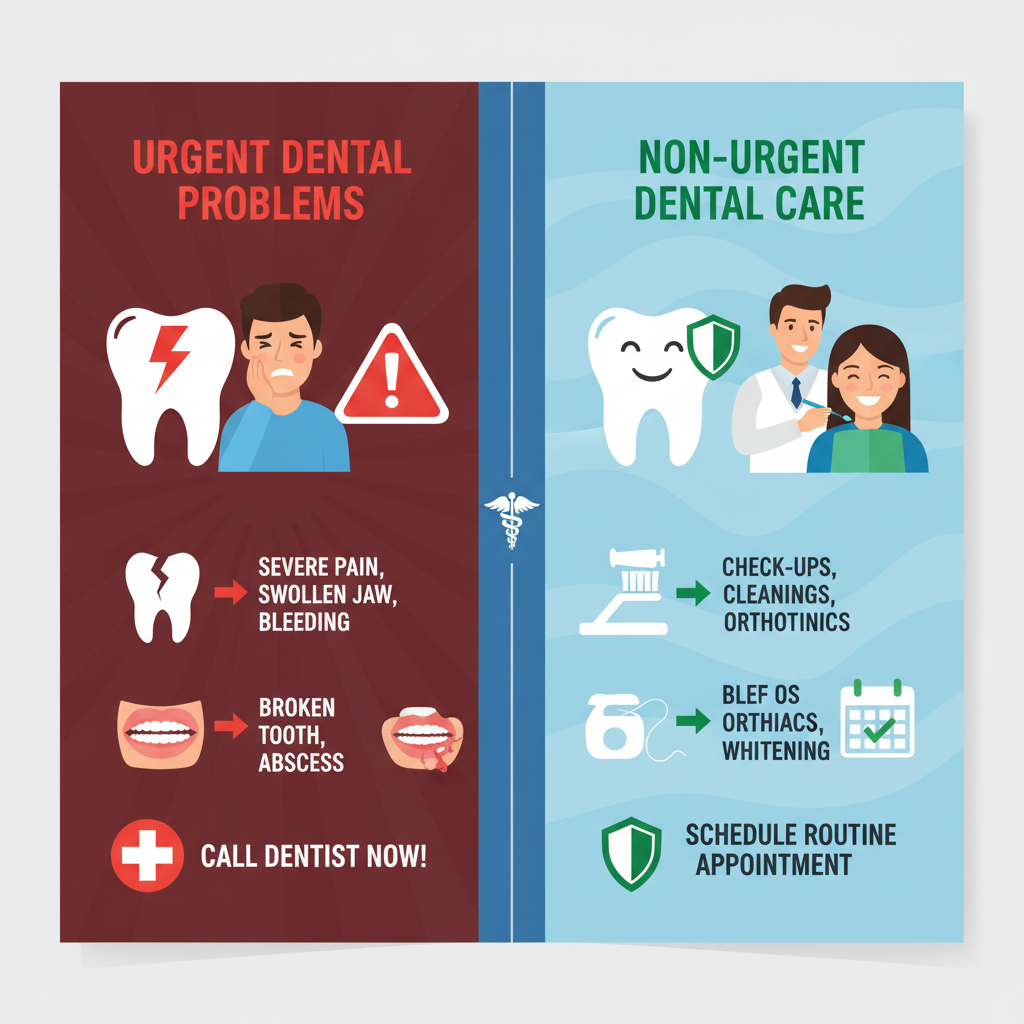
You can think of urgent vs non urgent dental problems in terms of risk. Urgent issues threaten your tooth, your health, or both if treatment is delayed. Non urgent issues are uncomfortable or inconvenient, but they are unlikely to cause serious harm if you wait a short time for care.
Here is a simple comparison to help you decide how quickly to act:
| Situation type | Examples | How fast to act |
|---|---|---|
| Clearly urgent emergency | Knocked out tooth, severe swelling, uncontrolled bleeding, intense tooth pain, suspected abscess, broken jaw | Call an emergency dentist or go to ER right away |
| Urgent but not life threatening | Badly cracked tooth with pain, lost filling with strong sensitivity, facial swelling without breathing problems | Same day or within 24 hours |
| Non urgent but needs care | Minor chip without pain, dull toothache that comes and goes, lost crown with only mild sensitivity | Schedule soon, within a few days |
| Routine care | Checkups, cleanings, small cavities, cosmetic concerns | Schedule at your convenience |
Understanding where your situation fits on this spectrum can guide your next steps. If you are still unsure, articles like urgent dental issues explained and dental emergencies vs routine dental care provide more context.
When tooth pain is urgent vs non urgent
Tooth pain is one of the most common reasons people seek emergency dental care. It ranges from mild, occasional sensitivity to intense pain that keeps you awake at night. Knowing when tooth pain is an emergency can help you act quickly when it matters most.
Signs tooth pain is an emergency
Tooth pain is usually urgent if:
- The pain is severe, throbbing, or radiates to your jaw, ear, or head
- It keeps you from sleeping or functioning normally
- It worsens when you lie down or bite down
- Pain has lasted more than 24 hours and is getting worse, not better
- It is paired with swelling of your face, gums, or jaw
- You notice a pimple-like bump on your gums, pus, or a foul taste
- You have a fever or feel generally unwell
Severe, persistent tooth pain like this can signal an infection or abscess. Ignoring it can lead to nerve damage, tooth loss, or spread of infection, which can become dangerous [3]. In these situations you should seek immediate care, and learning how to handle sudden dental pain can help you manage symptoms while you arrange treatment.
Resources like how to know if tooth pain is emergency, when tooth pain becomes serious, and how long can you wait for tooth pain can give you additional guidance, but if you are in intense pain, you should not delay calling a dentist.
When tooth pain can usually wait
Tooth pain may be non urgent if:
- The discomfort is mild and occasional
- It only occurs with very hot, cold, or sweet foods
- There is no swelling, fever, or visible damage
- Over the counter pain relievers control the pain
- It improves over a day or two rather than worsening
Even if the situation is not urgent, it still deserves attention. Mild toothaches can be early signs of decay, gum disease, or cracked teeth. Getting seen soon can prevent a small issue from escalating into an emergency that requires more extensive treatment [4].
Trauma: chipped, cracked, or knocked out teeth
Dental injuries are another area where it helps to clearly understand urgent vs non urgent dental problems. Trauma can range from a small chip in the enamel to a tooth that is fully knocked out.
Knocked out or loose teeth
A knocked out permanent tooth is always a true emergency. The best chance of saving the tooth is usually within 30 to 60 minutes [5].
If your tooth is knocked out:
- Pick it up by the crown, the white part, not the root
- If dirty, gently rinse it with water, do not scrub
- If you can, place it back into the socket and gently bite down to hold it in place
- If that is not possible, keep it moist in milk or a tooth preservation solution, or between your cheek and gums
- Seek emergency dental care immediately
The same is true if a tooth is suddenly very loose without a clear cause, or if your tooth seems pushed up or down from its normal position. These are urgent problems that require prompt care to save the tooth and protect the surrounding bone. You can read more in how to identify dental trauma severity and when to go to an emergency dentist.
Cracked or fractured teeth
A cracked tooth can be urgent or non urgent depending on the severity:
You likely need urgent care if:
- The tooth is badly fractured or split
- Pieces of the tooth are moving
- You have sharp pain when biting down
- The crack extends below the gumline
- There is visible bleeding or a dark spot inside the crack
In these cases, you should seek same day or next day treatment. Waiting can allow bacteria to reach the pulp, leading to infection and more complex care. If you are unsure, resources like is a cracked tooth an emergency and what dental issues require immediate treatment can provide more clarity.
Cracks that involve only the very outer layer of the tooth, with no pain or sensitivity, are typically less urgent, but you should still schedule a prompt evaluation.
Chipped teeth
A chipped tooth often feels alarming but is not always an emergency.
You likely need urgent attention if:
- The chip is large and exposes the inner yellow or pink part of the tooth
- You have significant pain or sensitivity
- The sharp edge is cutting your cheek or tongue
- There is bleeding from the tooth itself
If you only have a small chip, no pain, and no sharp edges, it usually can wait a short time for a scheduled visit. Even so, it is important to have it checked to prevent further cracking. Helpful resources include is a chipped tooth a dental emergency and how to identify dental trauma severity.
Swelling, infections, and abscesses
Swelling around your teeth, gums, or face is a key sign that an issue may be urgent. Swelling often means there is an infection. Left untreated, dental infections can spread to other parts of your body and become dangerous.
When swelling is an emergency
You should seek immediate care if:
- Your cheek, jaw, or area under your eye is swollen
- Swelling is spreading or getting worse quickly
- You have difficulty swallowing, breathing, or opening your mouth
- You have a fever or feel very unwell
- There is a visible abscess, a painful swollen spot on your gums, that may drain pus
Facial swelling and dental abscesses like these require urgent dental or medical treatment to prevent the infection from spreading to the bloodstream or other areas [6]. You can learn more about these warning signs in dental emergency symptoms to watch for and when gum swelling is an emergency.
While you wait for care, you can:
- Rinse gently with warm salt water
- Apply a cold compress to the outside of your face
- Take over the counter pain relievers as directed, unless your doctor has told you not to
You should not place aspirin directly on your gums, since this can burn the tissue [7].
When swelling can wait a short time
Mild gum swelling without pain, fever, or spreading may not be an emergency, but it is still a sign that something needs attention. Early gum disease, small infections, or irritation can often be treated more easily if you schedule an appointment soon. Regular dental care reduces the risk that these issues will progress into urgent infections [8].
Bleeding from the mouth
Bleeding can be confusing because it ranges from minor gum irritation to serious emergencies.
When bleeding is urgent
Seek immediate help if:
- Bleeding does not stop after 10 to 15 minutes of firm pressure
- Bleeding is heavy or you are swallowing large amounts of blood
- Bleeding follows an injury to your face or jaw
- You feel dizzy, weak, or faint
- Bleeding continues more than an hour after a dental extraction despite following instructions
Uncontrolled bleeding is an urgent dental problem that requires prompt professional care to prevent complications [9]. Guidance in when bleeding gums are an emergency and emergency dental warning signs can help you recognize when to act.
For immediate self care while you seek help:
- Place clean gauze or a folded, clean cloth over the area
- Bite down with steady pressure
- Stay upright and avoid spitting or rinsing too vigorously
If bleeding follows a major trauma or is accompanied by facial injury, you may need to go directly to an emergency room [10].
When bleeding is usually non urgent
Mild bleeding from the gums when you brush or floss is often a sign of gum irritation or early gum disease. While this is not typically an emergency, it should not be ignored. Scheduling a dental exam and cleaning can help address the source before it becomes more serious.
If you are unsure whether your bleeding is urgent or not, it is safer to call a dentist, describe your symptoms, and ask if you should be seen right away.
Lost fillings, crowns, and other dental work
Problems with existing dental work are common, and they can range from inconvenient to urgent.
Situations that are more likely to be urgent include:
- A lost filling or crown that exposes a large area of tooth and causes strong pain or sensitivity
- Sharp edges that cut your tongue or cheek
- A broken denture or appliance that is causing sores or cannot be worn at all
Loose or missing fillings and crowns can expose tooth nerves and increase the risk of infection, so it is important to address them promptly [11]. Many of these situations are considered urgent but not life threatening, so same day or next day appointments are usually recommended.
Less urgent situations might include:
- A crown that comes off but the tooth is not painful and you can cover it temporarily
- A small chip on a filling with no sensitivity
- Mildly loose dentures that still function
Non urgent dental problems like these still need attention, but they usually can wait for a normal appointment time [10].
If you are in this position, what to do before seeing emergency dentist can offer step by step tips to protect your tooth while you wait.
When to choose an emergency dentist vs ER
Deciding where to go is part of understanding urgent vs non urgent dental problems.
In most dental emergencies, an emergency dentist is the best place to start. Emergency dentists can:
- Diagnose the problem
- Provide pain relief
- Perform procedures like fillings, root canals, extractions, and repairs
Emergency rooms are not equipped to provide dental treatments like fillings or crowns. They may offer pain medication or antibiotics but will still refer you to a dentist for definitive care [7]. Some emergency dental clinics specifically note that ERs do not treat tooth pain and advise you to seek dental providers directly instead [12].
You should go to an ER or call emergency services if:
- You have trouble breathing or swallowing
- You have severe facial trauma or suspected broken facial bones
- Bleeding will not stop and is heavy
- Swelling is affecting your eye, neck, or airway
For most other urgent dental problems, an emergency dentist or urgent dental clinic is appropriate. Many practices now offer same day or after hours care at rates similar to standard visits and accept most dental insurance plans, with financing options for those without coverage [13].
You can use resources like when to go to an emergency dentist and what dental issues require immediate treatment to help decide your next step.
At home steps while you seek care
While you arrange an appointment, there are safe measures you can take to reduce pain and prevent further damage.
General tips include [14]:
- Rinse gently with warm water to keep the area clean
- Use a cold compress on the outside of your cheek for pain or swelling
- Take over the counter pain relievers as directed, unless advised otherwise by your physician
- Apply gentle pressure with clean gauze for minor bleeding
- Avoid very hot, cold, or sugary foods that may worsen pain
- Do not chew on the affected side
For knocked out teeth, broken teeth, or lost crowns, additional detailed steps are covered in how to identify dental trauma severity and what to do before seeing emergency dentist.
You should not:
- Place aspirin directly on your tooth or gums
- Use sharp tools to pick at your teeth or gums
- Ignore severe or worsening symptoms
At home care is only a temporary measure. Persistent pain, swelling, or other serious signs always require professional evaluation.
Preventing urgent dental problems in the future
Many urgent dental issues cannot be predicted, especially accidents or sudden trauma. However, you can reduce your risk of emergencies by:
- Keeping regular checkups and cleanings to detect problems early
- Treating small cavities or cracks before they worsen
- Practicing good daily oral hygiene
- Wearing a mouthguard for sports or if you grind your teeth at night
- Avoiding chewing ice, hard candies, or non food objects that can crack teeth
Ignoring dental problems until they become emergencies can also affect more than your mouth. Untreated oral infections and gum disease have been linked to serious health conditions like cardiovascular disease, diabetes, respiratory infections, and complications during pregnancy [4]. Regular care is usually less painful and less expensive than emergency treatment, and it protects your overall health.
If you want to explore this topic further, dental emergencies vs routine dental care offers a helpful overview of how preventive visits and urgent visits work together.
Understanding urgent vs non urgent dental problems gives you a clearer path forward when something feels wrong. If you experience severe pain, swelling, uncontrolled bleeding, or trauma to your teeth or jaw, consider it urgent and seek care right away. For milder symptoms, schedule an appointment soon and use resources like signs you need emergency dental care and emergency dental warning signs to help you decide how quickly to act.
When you listen to what your mouth is telling you and respond promptly, you protect not only your smile but your overall health.
References
- (Penn Dental Medicine, Cleveland Clinic)
- (Penn Dental Medicine, Cummings Dental)
- (Cent Report Smiles, Roots & Gums of the Tri Valley)
- (Penn Dental Medicine)
- (Roots & Gums of the Tri Valley, Cent Report Smiles)
- (Cent Report Smiles, Roots & Gums of the Tri Valley, Edgerly Dentistry)
- (Cleveland Clinic)
- (Dental Care of Westlake, Penn Dental Medicine)
- (Roots & Gums of the Tri Valley, Edgerly Dentistry)
- (Cleveland Clinic, Dental Care of Westlake)
- (Cent Report Smiles, Cleveland Clinic)
- (Emergency Dental of Las Vegas)
- (Emergency Dental of Las Vegas, LV Smile)
- (Cleveland Clinic, Edgerly Dentistry, Dental Care of Westlake)