Long term oral health after tooth extraction means more than getting through healing. Once the painful tooth is gone, your mouth starts adjusting, and what happens next affects your bite, your bone, your gums, and your chances of avoiding another dental emergency. If you want the extraction to solve a problem instead of starting a new one, this is the part that matters.
What Long-Term Oral Health After a Tooth Extraction Really Means
A 2021 World Health Organization report estimated that oral diseases affect 3.7 billion people worldwide. That number matters because tooth loss rarely happens in isolation. It usually sits at the end of a longer story involving decay, infection, gum disease, delayed care, or trauma.
Long-term oral health after extraction is everything that happens after the socket closes. It includes how stable your jawbone stays, whether nearby teeth shift, how evenly your bite comes together, how easy chewing feels, how clearly you speak, and whether the same disease process that destroyed one tooth keeps moving through the rest of your mouth.
What this means in practice is simple: extraction ends the pain from a bad tooth, but it does not end treatment. It starts a new phase. If you manage that phase well, you protect the rest of your mouth. If you ignore it, the empty space and the original disease keep working against you.
The action for this stage is direct: treat your extraction as the beginning of a plan, not the end of a crisis.
Why a Tooth Extraction Changes More Than One Tooth
The WHO also reports that complete tooth loss affects almost 7% of adults over 20 and 23% of adults over 60. Tooth loss changes function over time because your mouth works as a connected system. Every tooth helps hold spacing, share pressure, guide chewing, and support a balanced bite.
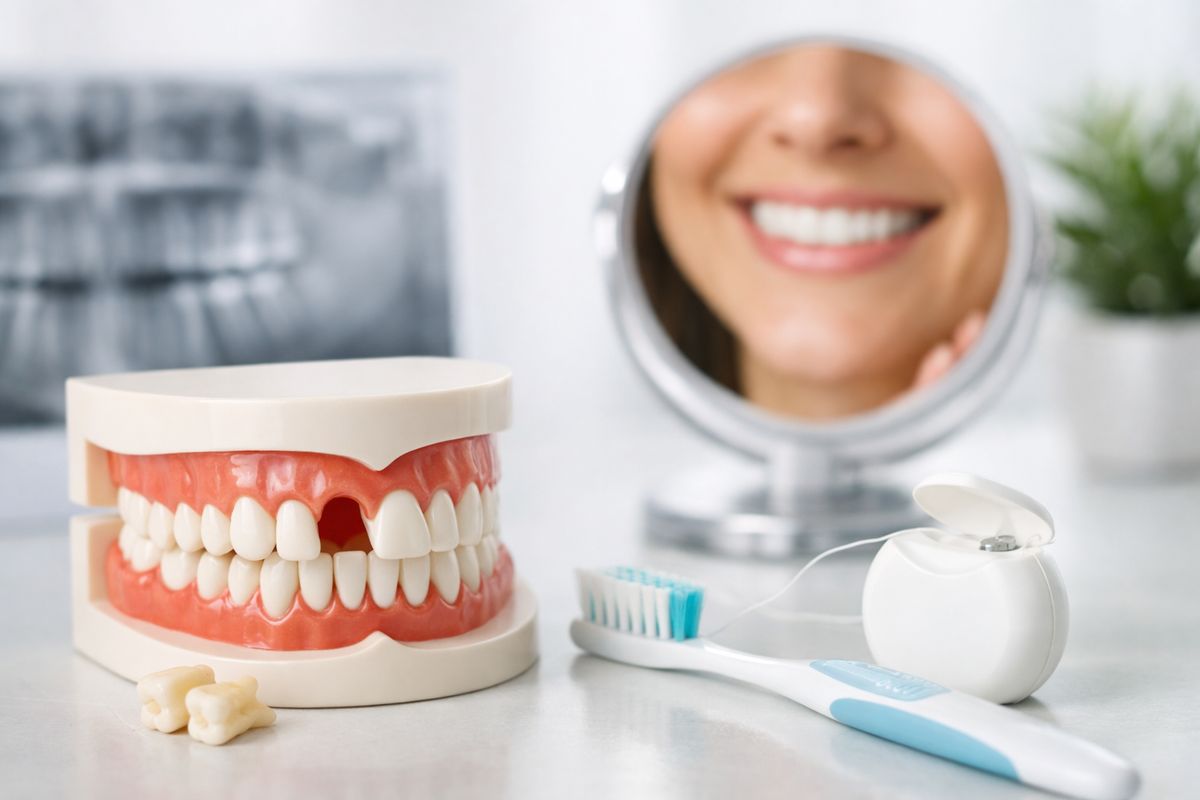
When one tooth is removed, the rest of your mouth does not stay frozen. The jawbone in that area starts shrinking. The teeth next to the gap lose support from the side. The tooth above or below the gap can start moving because it no longer meets resistance. Chewing pressure gets pushed onto fewer teeth. That extra load creates wear, cracks, soreness, and tension in the jaw joints.
Here’s the simplest version of this: the empty space is not passive. It changes the neighborhood around it.
The practical takeaway is clear. Leaving the area unmanaged creates bigger problems than the extraction itself.
Jawbone loss starts after the tooth is gone
Periodontics research consistently shows that the jawbone loses stimulation after the root is removed. Your tooth root acts like a signal to the surrounding bone. Every time you bite and chew, that signal tells the bone to stay active. Once the root is gone, the bone no longer gets that message, so it starts shrinking.
This is called alveolar bone loss, but the plain-English version is easier: the ridge that held the tooth begins to collapse. Over time, that affects facial support, changes how dentures fit, and limits future implant options because there is less bone available to anchor a replacement tooth.
That is why timing matters. If you wait too long to think about replacement, your future choices narrow. Bone grafting can help in many cases, but preserving options from the start is easier than rebuilding lost structure later.
The action that works is straightforward: plan for tooth replacement early, even if treatment happens after full healing.
Nearby teeth can drift and change your bite
Research on missing teeth and bite stability shows the same pattern again and again: teeth move when space opens up. The teeth next to the gap can tilt inward. The opposing tooth can over-erupt into the open space. What starts as a small shift turns into harder cleaning, plaque buildup, uneven biting pressure, and areas that trap food every day.
This is where long-term problems start stacking up. Crowded or tipped teeth are harder to keep clean. Uneven contacts create wear and jaw strain. Bite changes can contribute to clenching, headaches, and soreness around the joint in front of the ear.
If you have already had emergency treatment, this is the stage to think beyond relief. A missing tooth in the back of your mouth may not seem urgent because nobody sees it, but your bite notices.
The practical move is to schedule a replacement consultation before drifting starts. If you need help building stable habits after urgent treatment, this guide on keeping your mouth healthy after emergency care gives that transition a clearer structure.
When Extraction Helps Your Long-Term Health
A Swedish pediatric study on first permanent molars affected by MIH found that extraction was linked to a greater proportion of clinically meaningful improvement in oral-health-related quality of life. The details involved children, but the bigger point carries into adult care too: when a tooth is truly beyond saving, removing it improves life.
That improvement is not only about pain. A badly infected, fractured, or non-restorable tooth keeps damaging the surrounding tissues. It can keep draining infection into the gums and bone. It can make chewing uneven and keep you stuck in a cycle of swelling, tenderness, and repeat urgent visits.
What this means in practice is important: extraction is the right move when the tooth is no longer a healthy structure worth defending.
The action is simple. If a tooth is unsalvageable, treat it quickly and protect the rest of your mouth.
A hopeless tooth keeps damaging the area around it
Research on advanced decay and periodontal breakdown makes one fact obvious. A tooth with severe decay into the root, infection spreading into the bone, a fracture below the gumline, or advanced gum disease does not sit quietly. It continues to destroy support tissue.
Delayed care often turns a fixable problem into an extraction. Then more delay turns one extraction into a larger pattern of bone loss, shifting teeth, and additional treatment. That is why relief-driven emergency care matters so much. It stops active damage.
If your tooth was removed because it was beyond repair, that was not a failure. It was disease control. The move that works now is protecting the teeth and bone that remain.
The practical step: if a tooth is declared non-restorable, move forward without delay so the surrounding area stops taking damage.
Pain relief is only the first win
Quality-of-life research after dental extraction consistently shows improvement in comfort, function, and daily routine once a source of infection or severe pain is removed. Better sleep, easier eating, less swelling, and no more constant flare-ups change your day fast.
But pain relief is only the first win. Once pain drops, you can brush better, eat more normally, and think clearly about prevention instead of just survival. That shift matters because neglected routine care often starts with one painful tooth that makes the whole mouth harder to manage.
Here’s how to use that window: once the crisis is over, focus on rebuilding, not just recovering. If your mouth has fillings, crowns, or repairs from urgent care, this article on protecting dental work so it lasts helps you keep that progress from unraveling.
Extraction Is Not Automatically the Best Long-Term Choice
A 2026 endodontic surgery cohort found a 94.9% long-term success rate, with failure-free survival of 96.4% at 1 year, 92.7% at 3 years, and 87.3% at 5 years. That is a strong reminder that saving a tooth is often a very solid option when enough healthy structure remains.
Extraction is sometimes necessary. But “pull it and be done” is not automatically the best long-term choice. Your natural tooth supports bite force, keeps the bone stimulated, and helps preserve alignment. Once it is removed, replacement becomes a separate treatment decision with separate costs.
The core question is not just “What stops the pain fastest?” The better question is “What protects your mouth best over time?”
The action here is direct: before agreeing to extraction, make sure the tooth is truly non-restorable.
When saving the tooth protects your mouth better
Endodontic and restorative research supports tooth preservation when structure, periodontal support, and infection control make it realistic. Root canal treatment, a crown, periodontal therapy, or surgical repair can keep a tooth functioning for years.
That matters because a natural tooth still does the job it was built to do. It shares chewing forces, keeps the bone active through the root, and helps maintain spacing in a way no removable appliance fully matches. Saving a tooth often protects the whole system around it.
The practical note is the one that matters most: ask directly whether the tooth is truly beyond repair, or simply more expensive and time-consuming to save.
How cost, fear, and delayed care affect the decision
A lot of extractions happen under pressure. Pain is severe, money is tight, time is short, and dental anxiety is already high. In that moment, same-day removal feels like the only real option.
That reality deserves honesty, not judgment. The best long-term choice is the one that stops active disease and fits your ability to complete follow-up care. A tooth-saving plan that never gets finished is not better than an extraction that removes infection and leads to a realistic replacement plan.
What this means in practice is simple: ask for the full picture. Get the total cost of extraction alone, extraction plus replacement, and treatment to save the tooth. Then weigh the actual long-term value, not just the price of today’s visit.
The First Few Weeks Set Up the Next Few Years
Mayo Clinic data on dental extraction before cardiovascular surgery found that 5.7% had postoperative complications leading to an ER visit. Even though serious events were uncommon, that number makes the point clearly: extraction is not a throwaway procedure, especially when health is already complicated.
The first few weeks after an extraction shape the site that everything else depends on. Good healing protects the bone and gums. Poor healing creates setbacks that are harder and more expensive to correct later.
This article is not about step-by-step wound care, but the long-term principle is simple. Early healing quality matters. Protecting the site at the start protects your future options.
The concrete action: follow every post-extraction instruction exactly during early healing, because the damage from ignoring those rules does not stay limited to a few uncomfortable days.
Protect the blood clot and the bone underneath it
Oral surgery research on dry socket and socket healing points to the same mechanism. The blood clot is the foundation of healing. It covers exposed bone, supports new tissue, and gives the area a stable start. If that clot breaks down too early, pain increases and healing quality drops.
What this means in practice is not complicated. The first 72 hours are not negotiable. If the site heals cleanly, later planning for implants, dentures, or simple monitoring becomes much easier.
The practical step is to respect that early healing window completely. Small disruptions early create larger setbacks later.
Know the warning signs that need urgent care
Clinical guidance on post-extraction complications highlights a short list of problems that need fast attention: pain that gets worse after improving, a bad taste that does not go away, swelling that spreads, fever, prolonged numbness, trouble opening your mouth, or fluid passing between the mouth and nose after an upper extraction.
Socket infection often appears around two weeks after surgery. Upper extractions can occasionally affect the sinus. Nerve irritation is uncommon, but persistent numbness is never something to watch casually.
The move that works is quick response. If healing starts moving in the wrong direction, urgent care protects the site and prevents a small problem from becoming a costly one.
The Missing-Tooth Plan Matters: Replace, Close the Space, or Monitor
Research and clinical experience agree on this point: not every missing tooth should be managed the same way. The right plan depends on where the tooth was, how your bite works, how healthy your gums are, how much bone remains, and what budget and follow-up are realistic for you.
The mistake is assuming that doing nothing means no decision was made. Leaving the space open is still a decision. It has consequences, and those consequences get harder to reverse as time passes.
Here’s the practical framework. You have three broad paths: replace the tooth, close or adapt to the space as part of a planned bite, or monitor the area because the risk of change is low enough to accept. What matters is choosing intentionally.
The action is to get a missing-tooth plan on record before the site fades from attention and life gets busy again.
Dental implants: the closest match to a natural root
Evidence on implants consistently supports one major advantage: an implant replaces the root as well as the crown. That matters because root-level support helps preserve bone in a way a bridge or open space does not.
Implants work best when the bone and gums are healthy enough to support them and when infection has been brought under control. If you chew heavily in that area, want a fixed option, and do not want to rely on neighboring teeth for support, implants usually give the most natural function.
The practical note is simple: ask for an implant evaluation early, even if placement happens later. Bone loss narrows options over time.
Bridges and partial dentures: useful options when implants are not realistic
Prosthodontic treatment research shows that bridges and partial dentures remain useful, practical choices for many adults. A bridge restores function quickly and stays fixed in place, but it uses neighboring teeth for support. A partial denture usually costs less upfront and replaces several teeth when needed, but it demands more adaptation and regular maintenance.
There is no prize for choosing the fanciest option on paper. The best replacement is the one you can afford, clean, repair, and actually keep using.
What this means in practice: choose the option you can maintain consistently. An affordable plan that stays in your mouth beats an ideal plan that never happens.
When leaving the space open is acceptable
Some missing teeth create less disruption than others. A back tooth with low bite demand and stable neighboring teeth may be monitored rather than replaced right away. But that decision only makes sense after a clinical review of your bite, gum condition, chewing pattern, and risk of drifting.
An open space in a visible area, a heavy chewing zone, or a mouth already dealing with crowding and gum disease is much riskier. In those cases, “wait and see” often turns into “now everything shifted.”
The practical step is direct: if the space stays open, set a follow-up schedule to watch for movement, gum problems, and bite changes.
Gum Health and Bone Health Decide the Long Game
The WHO estimates that severe periodontal disease affects more than 1 billion people worldwide. Research also supports a bidirectional link between periodontal disease and systemic bone loss. That matters because the biggest long-term threat after one extraction is often the same process that caused the loss in the first place.
A missing tooth does not create future problems by itself. Ongoing plaque, gum inflammation, and bone breakdown do. If gum disease remains active, the rest of your teeth stay at risk no matter how well one extraction site healed.
This is the point where your focus has to widen. Long-term success is not just about one empty space. It is about the health of the whole mouth.
The action that works is to treat gum disease as the main enemy, not the extracted tooth.
If gum disease caused the extraction, the same process can threaten other teeth
Periodontitis is a chronic infection around the teeth that destroys the bone and tissues holding them in place. Bleeding gums, bad breath, deep pockets, loose teeth, and gradual bone loss all point in the same direction.
Removing one failed tooth does not stop that process elsewhere. If anything, it should make the situation clearer. Your mouth needs maintenance, not denial. If you want to avoid another emergency visit, regular periodontal care is the move that works.
That is also where a long-term dental relationship matters. If you have been relying on urgent visits, this guide on building an ongoing dental home after emergency treatment helps turn one crisis visit into consistent care.
Your general health affects healing and future tooth loss
The 2026 endodontic cohort found that systemic disease increased failure risk 5.87-fold. That number comes from tooth-preserving treatment, but the broader message applies here too. Your mouth is not separate from the rest of your body.
Diabetes, osteoporosis, immune conditions, tobacco use, dry mouth, and poor nutrition all affect healing and long-term stability. Some medications alter bone metabolism. Others reduce saliva, which raises decay risk fast. If you smoke or vape, extraction healing and gum stability both suffer.
The practical step is one sentence long: tell the dentist about every medical condition and every medication, because bone and gum risk do not stay confined to your medical chart.
Daily Habits That Protect Your Mouth After an Extraction
WHO prevention guidance stays refreshingly plain. Most oral disease is preventable. The basics are a diet lower in free sugars, no tobacco, less alcohol, and twice-daily brushing with fluoride toothpaste containing 1000 to 1500 ppm fluoride.
That matters even more after an extraction. Once one tooth has been lost, prevention becomes the cheapest and most effective way to protect the rest. You do not need perfect habits overnight. You need consistent ones.
The simplest version of this is not glamorous, but it works. Brush well. Clean between teeth. Reduce sugar frequency. Show up for follow-up care.
The action for this stage is to build a routine you can keep on your worst week, not your best one.
Brush with fluoride toothpaste and clean between teeth every day
WHO guidance supports twice-daily brushing with fluoride toothpaste because fluoride helps strengthen enamel and slow decay. Cleaning between teeth matters just as much because your toothbrush does not remove plaque well from tight spaces where gum inflammation starts.
If your extraction happened after years of putting off care, do not overcomplicate the restart. Anchor brushing and flossing to fixed points in your day, such as after waking up and before bed. Routine beats motivation.
What this means in practice: make oral care automatic. If you need a simple reset after urgent treatment or repairs, this article on what good home care looks like after dental work gives you a practical baseline.
Cut the habits that drive repeat dental emergencies
WHO prevention advice and emergency dentistry patterns point to the same repeat offenders: frequent sugar between meals, smoking, vaping, heavy alcohol use, and skipped cleanings. Those habits keep decay and gum disease active, even after the painful tooth is gone.
The key point is frequency. One dessert with dinner does less damage than sweet drinks or snacks hitting your teeth all day. Constant exposure feeds acid attacks and inflammation.
The practical move is to reduce sugar exposures between meals first. That single change often lowers your risk faster than people expect.
Special Situations: Wisdom Teeth, Children, Older Adults, and Medically Complex Patients
Mayo Clinic guidance and outcome data make one thing clear. Long-term planning after extraction changes with age, anatomy, and medical complexity. A straightforward extraction in a healthy young adult is not the same as a surgical removal near the sinus, a child losing a key tooth during growth, or an older adult managing multiple medications.
That is why generic advice fails. The right plan has to fit the person, not just the tooth.
The action here is to expect tighter planning when anatomy or health status raises the stakes.
Wisdom tooth extraction has its own long-term issues
Mayo Clinic notes that impacted wisdom teeth are often removed because of pain, infection, gum disease, decay, damage to neighboring teeth, cyst risk, or cleaning difficulty. Removal in the late teens or early 20s is often better tolerated because roots are less developed and healing is usually easier.
If wisdom teeth are already causing repeat inflammation, waiting rarely improves the situation. Repeated swelling around a partially erupted wisdom tooth tends to keep coming back.
The practical step is direct: if wisdom teeth keep flaring up, get them evaluated early before the problem damages the tooth in front of them or creates a larger surgical issue.
Children and teens need growth-aware planning
The Swedish MIH study found that extraction often required fewer visits and shorter chair time, and it was linked to meaningful quality-of-life improvement. But timing in younger patients carries extra weight because spacing, eruption, and orthodontic development are still in motion.
A child or teen can benefit from extraction and still need active planning afterward. Space can close in the wrong way. Bite development can drift. What looks solved today can become an orthodontic problem later if nobody tracks it.
The practical note is simple: after a child’s extraction, ask specifically whether space management or orthodontic follow-up is needed.
Older adults and medically complex patients need tighter follow-up
The Mayo Clinic study on extraction before cardiovascular surgery found ER-level postoperative complications in 5.7% of cases. That does not make extraction unsafe across the board. It does show that health complexity changes the risk picture.
Older age often comes with dry mouth, bone loss, slower healing, more medications, and a narrower margin for infection or delayed recovery. If you have chronic illness or take multiple medications, routine follow-up matters more, not less.
The practical move is to book follow-up sooner than you think you need. Early review catches problems while they are still easy to manage.
What to Do This Week to Protect Your Long-Term Oral Health
One post-extraction appointment focused on the missing-tooth plan is the move that matters most this week. Use that visit to decide one of three paths: replace the tooth, monitor the space on purpose, or treat the gum disease or decay pattern that caused the loss in the first place.
That one appointment changes the trajectory. It turns an emergency into a plan. It gives you a chance to protect your bite, preserve your bone, and stop the cycle that leads back to urgent pain.
If you have already had emergency care, do not let the site fade into the background and hope for the best. Return for ongoing care, get a clear long-term plan, and give your mouth a real chance to stay out of crisis.
References
- dentalhealth.org
- link.springer.com
- mayoclinic.org
- nature.com
- pmc.ncbi.nlm.nih.gov
- pmc.ncbi.nlm.nih.gov
- sciencedirect.com
- who.int