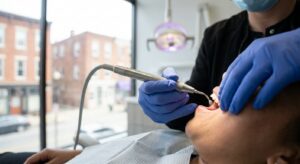
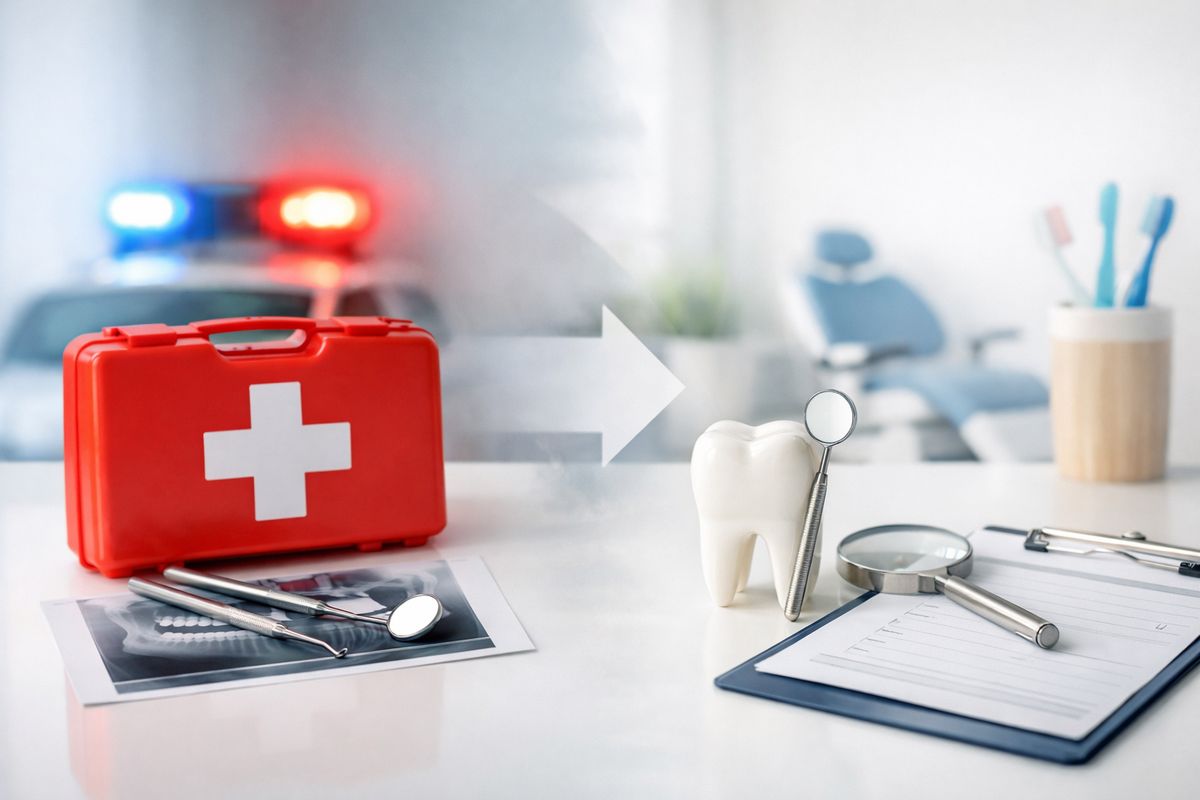
A dental emergency feels finished the moment the pain drops, but that is usually the most dangerous point to stop. The ADA estimates about 2 million dental-related emergency department visits happen every year, and most of those visits deliver temporary relief, not a real fix. If you are focused on finding a regular dentist after emergency visit care, the goal is simple: turn one urgent appointment into stable, ongoing treatment before the same problem sends you back into crisis.
Why the emergency visit is only the first step
ADA data shows roughly 2 million emergency department visits each year are tied to dental pain, and emergency settings usually handle pain, swelling, antibiotics, or referral rather than definitive dental treatment. What this means in practice is blunt: your tooth, infection, fracture, or gum problem usually remains active after the visit ends.
That gap matters because emergency medicine is built to stabilize you, not become your dental home. If you had facial swelling, severe pain, a cracked tooth, or an abscess, the first visit lowered the immediate risk. It did not remove decay, complete a root canal, restore a broken tooth, or build a long-term plan to keep the problem from coming back.
This is why the move that works is finding a regular dentist immediately after the emergency, not after the next flare-up. In Baltimore, that means looking for an office that can take over diagnosis, treatment planning, prevention, and future urgent needs under one roof. A regular dentist gives you continuity, and continuity is what ends the cycle.
Get your follow-up scheduled before the pain fades
A CDC study on dental care use found adults lose 320.8 million work or school hours every year for dental care, including 92.4 million hours for emergency or unplanned visits. Waiting does not save time. It usually costs more time, more missed work, and another painful disruption when the problem returns.
The simplest version of this is to book follow-up while the emergency still feels urgent. Once pain medicine starts working, it gets easy to tell yourself the issue is handled. It is not. Schedule the comprehensive dental exam within days of the emergency visit, not weeks later. That timing makes records easier to transfer, symptoms easier to explain, and treatment easier to start before the condition worsens.
You also need to know when to seek immediate care again. Swelling that grows, fever, drainage, difficulty swallowing, trouble opening your mouth, severe pain that breaks through medication, uncontrolled bleeding, or trauma that affects chewing all demand prompt dental attention. Relief from medication does not mean resolution.
Know what information to bring from the emergency visit
A 2024 care-coordination theme from ADA referral guidance focuses on continuity, and continuity improves when your next office has the full picture from day one. Your discharge summary, diagnosis notes, prescriptions, X-rays, billing paperwork, and any referral sheet all help a regular dentist move faster.
Here’s how to use it: gather every document before you call offices. Keep digital photos of discharge papers on your phone if needed. When a scheduler asks what happened, you can give a clean summary, confirm the diagnosis, and ask if the office can continue care based on those records. That saves you from repeating the same story five times and speeds up booking.
Watch for signs the problem is not actually resolved
ADA guidance on emergency dental care makes one point clear: symptom control is not definitive treatment. If you still have swelling, pressure, bad taste, drainage, throbbing pain, a broken tooth edge, sensitivity when biting, or trouble chewing, the problem is still active.
Even antibiotics can create false confidence. An infection can quiet down and then come back harder once the medication ends. A cracked tooth can stop hurting and still need a crown. A tooth with nerve damage can calm down and still need a root canal. If you want to avoid another urgent visit, assume lingering symptoms mean unfinished treatment and act on that assumption now.
Know what kind of regular dentist you actually need
ADA guidance around a dental home points patients toward ongoing care, not one-time repairs. That matters because most people leaving an emergency visit do not need to self-diagnose a specialist first. You need a dentist who can evaluate the whole situation, decide what must happen now, and sequence the rest.
A general dentist is the right starting point for most adults and families after an emergency. General dentists handle exams, treatment plans, fillings, crowns, preventive care, and many urgent problems. If a tooth needs a root canal, an extraction, advanced gum treatment, or trauma care beyond the scope of the office, the general dentist directs that referral in a way that actually fits the rest of your care.
Start with a general dentist for ongoing care
ADA care models consistently point to the dental home as the center of continuity. In plain English, that means one office knows your history, tracks your treatment, and helps you stay ahead of the next problem instead of reacting late.
For most emergency follow-up, a general dentist is the move that works. You get an exam, updated X-rays if needed, a clear diagnosis, and a realistic plan for what happens first, what can wait, and what matters most for your budget. You also get preventive care once the urgent issue is stabilized, which is what actually breaks the pattern of repeated emergencies.
If you recently had a tooth repaired and want to protect that result, building care around one office also makes it easier to stay on top of keeping dental work stable over the long haul.
Use a specialist only when the diagnosis clearly calls for it
A specialist makes sense when the diagnosis already points in that direction. Endodontists handle root canals. Oral surgeons handle surgical extractions, wisdom tooth problems, and some trauma cases. Periodontists handle advanced gum disease. Pediatric dentists treat children. But the catch is this: starting with a specialist before anyone coordinates the case often wastes time.
If your emergency paperwork says “possible abscess,” “fractured molar,” or “severe decay,” a general dentist should usually be your first call. That office can confirm the diagnosis, determine urgency, and send you to the right specialist if needed, with records in hand. That reduces repeat imaging, billing confusion, and delays.
Use the fastest search methods to find a dentist taking new patients
The ADA has emphasized that referral programs can reduce repeat emergency use and produce major system savings, in part because connecting patients to local dentists works better than leaving them to start from scratch. Speed matters here. You want the shortest path to a real appointment with a practice that offers ongoing care.
Start with the referral source closest to your emergency visit. Then verify through insurance or Medicaid directories. If cost blocks access, move quickly to community clinics or dental schools. Broad searching across the whole state slows you down. A targeted Baltimore-area search gets you to an exam faster.
Call the emergency clinic or hospital for referral options
ADA referral-program models are built around direct handoff, and direct handoff is usually faster than a cold search. If your emergency care happened in a hospital, urgent dental clinic, or emergency room, call back and ask for local follow-up options. Ask for offices near your neighborhood, your bus line, or your work route.
In Baltimore, local provider networks matter more than a giant directory full of names you cannot reach or cannot use. Ask specifically for offices that accept your insurance or Medicaid and are known to see follow-up cases after emergency treatment. That one call often saves an hour of dead-end searching.
Check insurance and Medicaid directories the right way
Marvellous Akinlotan of Texas A&M summed up the access problem clearly: coverage without access does not translate into care. That line explains why so many directory searches fail. A dentist can appear on a list and still not be active, not be taking new patients, or not be scheduling adult Medicaid appointments right now.
Here’s how to use that reality. Treat directories as leads, not proof. Call the office and ask three direct questions in one breath: do you accept my exact plan, are you taking new patients, and can you schedule comprehensive follow-up after emergency treatment started elsewhere? If any answer is unclear, move on. Precision beats optimism here.
Look at community clinics and dental schools if cost is the barrier
Research on emergency dental use consistently shows cost and access drive people into the ED. Community health centers, federally qualified health centers, dental schools, and local dental programs exist for exactly this gap. If private offices have long waits or require fees you cannot handle upfront, these settings are a strong path into regular care.
This is not a backup for people who “failed” the usual route. It is a practical route. Many low-income adults and families get stable treatment through community programs because the office structure is built for payment barriers, Medicaid, and staged treatment plans. If your main concern is cost, act on that directly and look for care settings designed to meet it.
Ask these questions before you book
A 2023 healthcare access theme across dental policy research is simple: continuity depends on actual access, not theoretical benefits. So do not waste calls on vague conversations. Ask the questions that expose whether an office can realistically become your regular dentist.
Do you accept my insurance, including adult Medicaid?
This comes first because it prevents dead-end scheduling. One-third of ED dental spending is paid by Medicaid, according to the ADA, which tells you how common this issue is. But Medicaid participation varies by office, by age group, and by the type of treatment offered.
Ask whether the office accepts your exact plan for adults, whether new Medicaid patients are being scheduled now, and whether follow-up treatment from an emergency visit is covered the same way as a new exam. If you have commercial insurance, ask about copays, annual maximums, and whether outside X-rays can be used. The action is simple: confirm money before time.
Are you taking new patients and how soon is the first exam?
A fast appointment matters after an emergency because the condition is active even if it feels quieter. Ask the first available new-patient exam date, whether urgent follow-up slots are held open, and whether you can join a cancellation list.
If the first exam is three months away, that office is not your best next move. You need a practice that can see you soon enough to convert emergency stabilization into treatment. Speed is not a luxury here. It is part of the clinical decision.
Can you treat anxious patients without judgment?
Dental anxiety is not a side issue. It is one of the main reasons people delay care until pain forces action. If an office is dismissive on the phone, believe that signal.
Ask whether the practice is comfortable seeing patients who have not had dental care in a long time, whether numbing is explained clearly, whether sedation options exist, and whether the team uses calm, step-by-step communication. The right office makes it easier to come back. That is how you stop emergency-only care from defining your dental life. After treatment starts, staying healthier after urgent dental care becomes much more realistic.
What will the first visit cost if I pay out of pocket?
A 2024 consumer access pattern in dental care shows one stubborn truth: people delay treatment when pricing feels hidden. You do not fix that by staying quiet. You fix it by asking for a clear number.
Ask for the self-pay cost of the first exam, any needed X-rays, and treatment planning. Ask whether outside X-rays reduce the charge. Ask whether payment plans or phased treatment are available if more work is needed. Clear pricing is not awkward. It is part of choosing a dentist you can keep using.
Choose a dental home you can actually keep using
The dental home concept matters because prevention beats repeated emergency care every time. ADA cost comparisons show ED dental visits often cost about three times as much as a dentist visit while still leaving the underlying problem untreated. The best regular dentist is not the office with the flashiest website. It is the office you can return to consistently.
Pick convenience that fits your real life
A 2024 access trend in oral health services shows that logistical friction blocks follow-through as effectively as cost. If the office is hard to reach, hard to park at, impossible after work, or incompatible with your child care schedule, you will not keep going.
Choose a location near home, work, public transit, or a route you already use. Evening hours matter. Family block scheduling matters. A realistic office beats an ideal-looking office every time. If you want to break the cycle that sends people back into urgent pain, convenience is part of prevention.
Look for preventive care, not just emergency fixes
Emergency-only treatment keeps you in reaction mode. A regular dentist should offer cleanings, routine exams, treatment planning, and follow-up tracking after the urgent issue is handled. That is the structure that reduces future pain and future cost.
If an office only seems interested in patching one problem and moving on, keep looking. You want a practice that shifts you from emergency visits to maintenance. That is how small cavities stay small, unstable fillings get monitored, and gum disease gets treated before it becomes another crisis.
Pay attention to communication and respect
A good long-term fit is obvious in the first few interactions. You get clear explanations. You get written estimates. You get direct answers about timing and cost. You do not get shamed for waiting too long, missing past care, or needing phased treatment.
Respect matters because it drives return visits. If you feel dismissed, embarrassed, or rushed, you will delay care again. The right office prioritizes the urgent issue, explains the larger plan, and treats you like someone worth keeping healthy.
Avoid the mistakes that lead back to the ER
ADA figures put non-hospitalized ED dental visits around $749 on average, compared with roughly $90 to $200 for a dentist visit. Paying more for less treatment is the pattern you want to break. Most repeat emergencies come from a handful of preventable decisions.
Waiting until the medication runs out
Antibiotics and pain medicine buy time. That is all. They do not remove decay, repair a fracture, or complete a root canal. When you wait until the prescription ends, you lose the window when treatment is easiest to schedule and easiest to tolerate.
The move that works is booking before the bottle is empty. That one decision reduces the chance of rebound pain, new swelling, and another expensive urgent visit.
Choosing based on the first online listing alone
Search results are not quality control. Insurance data can be outdated. Some offices do not provide ongoing care. Some focus on limited services and refer most treatment elsewhere.
Use online listings to generate names, then verify everything by phone. A fast click is not the same as a good fit. You need a practice that accepts your payment method, sees new patients soon, and offers continuity after the first appointment.
Ignoring cost conversations out of embarrassment
Cost avoidance is one of the fastest routes back to pain. If you feel embarrassed discussing money, you are more likely to delay, cancel, or disappear after the exam.
Bring cost into the first call. Ask about payment plans, phased treatment, community options, and what must be done now versus what can be staged. Once money is out in the open, your care plan gets real.
Finding a regular dentist in Baltimore on a tight budget
ADA data shows one-third of emergency dental spending is paid by Medicaid, and research on ED use keeps finding the same thing: uninsured adults and people with limited access are pushed toward crisis care. In Baltimore, the smartest path is the one that matches your actual constraints, not the one that assumes perfect coverage and unlimited flexibility.
Best paths for Medicaid recipients
Start by confirming your current adult dental benefits and your exact plan details. Then call offices and ask if adult Medicaid patients are being accepted now for comprehensive care, not just extractions or emergency visits.
That wording matters. You are not looking for a one-time fix. You are looking for a dental home. If a practice accepts Medicaid and provides follow-up exams, treatment planning, preventive visits, and referrals when needed, you have found the right category of care.
Options if you do not have insurance
Uninsured adults are the group most likely to rely on the ED for dental conditions, according to the research. That makes speed even more important. Ask private offices for self-pay exam pricing. Compare that with community clinics, dental schools, and discount plans.
Also ask whether treatment can be phased. You may need the painful tooth handled first and the rest sequenced over time. That is a valid plan. The goal is not to buy perfect dentistry in one day. The goal is to secure a regular office and stop the emergency cycle.
What to do if transportation or work hours are the issue
The CDC data on lost work and school hours shows how deeply oral health collides with real life. If your biggest barrier is getting there, search by bus route, work commute, and evening availability before you search by anything else.
Ask whether the office offers early, late, or family-block appointments. Ask how long the first visit usually takes. If you need care that fits around a job or child care, say that directly. Practical scheduling is not a side issue. It is what makes ongoing care possible.
What to do this week to lock in a regular dentist
Use your emergency paperwork and make three calls this week to Baltimore-area offices that fit your insurance, Medicaid status, or self-pay budget. Confirm plan acceptance, new-patient availability, and the date for a comprehensive follow-up exam, then book the first appointment before the week ends.
That single move changes everything. It turns emergency relief into treatment, treatment into prevention, and prevention into a real dental home. If you are ready to stop managing dental problems one crisis at a time, return for ongoing care and get the full plan in place now.