It has been two years since your last cleaning, maybe three, or maybe five, and you stopped counting a while ago. Now your gums bleed when you brush, your breath stays sour no matter what you try, or a tooth has started to throb. You suspect the tartar finally caught up with you. Before you pick up the phone, you want straight answers. What does a dental cleaning include? What will it feel like and what will it cost? Will anyone in Baltimore actually see you today? This guide from Baltimore Emergency Dental answers each question in plain language. Here, same-day emergency care and teeth cleaning happen in the same office.
Skipped cleanings are common. Money gets tight, work gets in the way, and one bad visit can keep you away for years. None of that changes your right to seek care today. It only changes which kind of cleaning your mouth may need and how much time the team sets aside for it.
What Does a Dental Cleaning Include? Six Steps, in the Order You Will Feel Them
A professional dental cleaning typically includes six steps:
- A visual exam
- Removal of plaque and tartar, called scaling
- Polishing
- Professional flossing
- A fluoride treatment
- A final check by the dentist
A routine visit often covers all six in about 30 to 60 minutes.
Here is how each step feels from the chair:
-
The visual exam. Before any tools touch your teeth, the team checks your gums, teeth, tongue, and cheeks with a small mirror and a light. You may feel a thin probe gently measuring the space between each tooth and gum. Healthy gums hug the tooth tightly. Deeper spaces, called pockets, can be a sign of gum disease. This step tells the team where to focus.
-
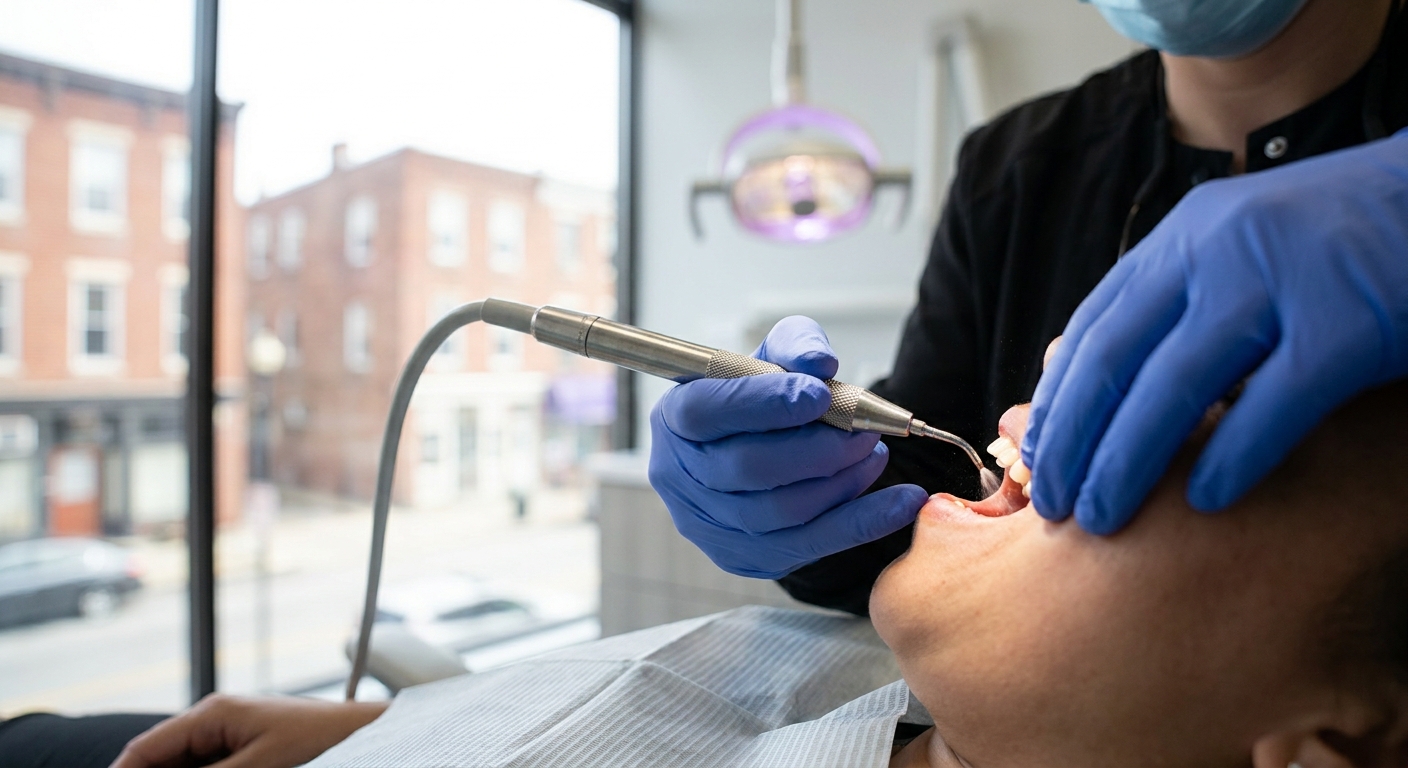
Plaque and tartar removal (scaling). This step takes the longest. Plaque is the soft, sticky film that builds up every day. Tartar, also called calculus, is plaque that has hardened onto your teeth, and brushing cannot remove it. Two kinds of tools do this work:
- An ultrasonic scaler vibrates quickly and sprays a cool mist of water to break up heavy deposits. You will hear a high-pitched hum and feel water pooling until a small suction tube clears it away.
- A hand scaler then scrapes off what remains, tooth by tooth. You will feel pressure and hear a scraping sound.
The more tartar present, the longer this step may run.
-
Polishing. A small rubber cup on a slow-spinning tool applies a gritty paste to each tooth. It feels like a firm, buzzing toothbrush. Polishing removes surface stains and leaves your teeth smooth, which can make it harder for new plaque to stick.
-
Professional flossing. Your teeth are flossed one gap at a time to clear out leftover paste and debris. If your gums are inflamed, they may bleed here. That bleeding is information, not failure. It shows exactly where your gums may need more attention at home.
-
Fluoride treatment. A fluoride varnish is painted on, or a foam or gel is placed in a tray that you hold in your mouth for a short time. Fluoride can help strengthen enamel. You may be asked to wait a little while before eating or drinking, and the team will tell you how long.
-
The dentist’s final exam. The dentist looks over your teeth and gums, reviews any X-rays, and checks for cavities, cracks, infection, or signs of gum disease. If something needs treatment, this is when you hear about it and talk through your options.
If it has been years, these same six steps still happen, but step two often changes. When tartar has built up below the gumline, a routine cleaning may not be enough, and the dentist may recommend a deep cleaning instead. The next sections explain how that affects your time and your cost.
How Long Does a Teeth Cleaning Take, and Will You Lose Your Whole Day?
A routine teeth cleaning often takes about 30 to 60 minutes. A deep cleaning, also called scaling and root planing, may take 60 to 90 minutes per visit and is sometimes split across two or more appointments.
Your time in the chair depends mostly on how much tartar has built up and how healthy your gums are. If you get cleanings on a regular schedule, scaling may go more quickly because there is less hardened buildup to remove. If it has been several years, the tartar may be thicker and may reach below the gumline, so the work has to be slower and more careful. A few things add time:
- Numbing the area, if you need it
- 3-D X-rays, if the dentist needs a closer look at the bone and roots
Deep cleanings are often done in sections. Your mouth is divided into four quadrants: upper right, upper left, lower right, and lower left. Many offices treat one or two quadrants per visit. Working this way has three benefits:
- Each appointment stays manageable
- You go home with only part of your mouth numb
- Your gums get time to respond between visits
Picture this: your gums have been bleeding for weeks, and one area is now sore when you chew. You call and get seen. The exam shows heavy tartar around that sore spot, so the team may start with the area causing the most trouble. You leave knowing what was done, what may still need to happen, and when to come back. Baltimore Emergency Dental is built around same-day emergency appointments. When you call, the goal is to get you into the chair quickly and start the most urgent work right away.
Routine Cleaning or Deep Cleaning: Which One Does Your Mouth Actually Need?
A routine cleaning, called prophylaxis, removes plaque and tartar from the teeth at the gumline and above it. It is meant for gums that are mostly healthy. A deep cleaning, called scaling and root planing, goes below the gumline to remove hardened tartar from the tooth roots and can be used to treat gum disease.
The difference matters because gum disease happens below the surface. Early gum inflammation is called gingivitis. If plaque and tartar stay in place long enough, the inflammation can move deeper and damage the bone and tissue that hold your teeth. That stage is periodontitis.
Treatment for periodontitis often involves a thorough cleaning that removes plaque and tartar from the tooth surfaces and from the pockets below the gumline, as explained in this patient guide on gingivitis and periodontitis from the NIH’s National Library of Medicine. Root planing smooths the root surfaces so the gums may have a better chance to tighten back around the tooth.
You are more likely to need a deep cleaning if you notice any of these:
- Gums that bleed when you brush or floss
- Bad breath that does not go away with brushing or mouthwash
- Tartar you can see, often a yellow or brown crust along the gumline
- Gums that look red, puffy, or pulled back from the teeth
- Teeth that feel loose or have shifted
Bad breath deserves a special mention. Many people try stronger mouthwash for months without results. When the odor comes from bacteria trapped in deep gum pockets, rinsing may not reach it. Cleaning out those pockets may be what helps make a difference.
You cannot always tell which cleaning you need by looking in the mirror. The dentist cannot always tell from a visual exam alone either. That is why Baltimore Emergency Dental uses 3-D X-rays when a closer look is needed. This imaging shows problems hidden below the gumline, including:
- Bone levels
- Infection near the root
- Other damage a mirror and probe cannot reach
With this view, your treatment plan can match what is actually going on in your mouth. It may also help the dentist see whether a painful tooth might be saved, instead of guessing.
Cleaning can also be tied to emergency care. You may have come in for a severe toothache, a dental abscess, or a tooth that needs an emergency extraction. In that case, the dentist may need to clean the area around it, before or during treatment, to clear away tartar and bacteria. The dentist decides the order. When you are in serious pain or have an infection, immediate pain relief and infection treatment often come first. The full cleaning may follow when your mouth is ready.
What Does Teeth Cleaning Cost in Baltimore, and Can You Afford It Right Now?
Without insurance, a routine teeth cleaning in the Baltimore area may cost around $75 to $200. A deep cleaning may run about $150 to $400 per quadrant, and the total depends on how many quadrants need treatment.
These are general estimates, not a quote. Your actual cost depends on four things:
- What the exam finds
- Whether you need X-rays
- Whether you need a routine or deep cleaning
- Your insurance plan
Quadrant pricing is where totals can climb. If only one quadrant needs a deep cleaning, you pay for one. If all four need it, the cost multiplies by four. That is why it pays to know the price before work begins.
Baltimore Emergency Dental accepts Delta Dental, Baltimore Medicaid, BCBS, Cigna, and Aetna. Coverage for cleanings varies by plan. Some plans treat a routine cleaning as preventive care and cover more of it, while deep cleanings may fall under a different benefit level. Bring your insurance card and ask the team to help you understand what your plan includes before treatment starts.
You may be worried that the bill will be more than you can handle right now. That worry is fair. Affordable care for underserved communities is central to how Baltimore Emergency Dental works, including for people who have put off care because of cost. If money is the reason you have waited, say so when you call. Ask what your visit may cost and which part of the work is most urgent. You have every right to know your options.
One honest point about cost: gum disease does not usually resolve on its own. Tartar can keep building and pockets can deepen. A problem that needs a cleaning today can turn into a problem that needs an extraction later. Getting seen sooner may mean less work, and less work may mean a smaller bill.
Can You Get a Same-Day Teeth Cleaning for a Dental Emergency in Baltimore?
Yes. Baltimore Emergency Dental offers both same-day emergency appointments and teeth cleaning. If pain, bleeding gums, or infection pushed you to call, you can often be seen and have treatment started the same day.
Many people assume an emergency dental office only handles broken teeth and extractions. They expect a cleaning to mean booking months out somewhere else. At Baltimore Emergency Dental, the two needs often show up together:
- A patient with a throbbing tooth may have years of tartar around it
- A patient with bleeding or swollen gums may be dealing with something urgent, even if it does not feel like a classic emergency
Treating the pain and cleaning the mouth are parts of the same problem, so it makes sense for one team to handle both.
The practice treats:
- Severe toothache
- Dental abscess and infection
- Broken or fractured tooth
- Knocked-out tooth
- Lost or broken filling or crown
- Bleeding or swollen gums
It also performs emergency tooth extractions, emergency root canal treatment, and dental implants. When cleaning is part of your care plan, it fits alongside that work instead of becoming a separate referral.
Baltimore Emergency Dental serves patients across Baltimore, MD. Call before you come in so the team knows what you are dealing with and can plan the right amount of time for you. To read more about the practice’s full range of services, visit the main site for same-day emergency dental care in Baltimore.
Important safety note: go to a hospital emergency room right away if you have any of these:
- Swelling that is spreading into your face, neck, or eye
- A high fever
- Any trouble breathing or swallowing
Those signs can mean a serious infection that needs immediate medical care.
What Happens During Your Cleaning Appointment at Baltimore Emergency Dental?
Your appointment follows a clear path, from check-in to leaving with a plan. Here is each step:
-
You call and check in. Tell the team what brought you in. It might be pain, bleeding, a bad taste, or simply knowing it has been too long. Bring your ID and your insurance card if you have one.
-
You update your medical history. List your medications, especially blood thinners, and any heart conditions, diabetes, or allergies. If you are pregnant, say so. Routine cleanings are generally considered safe during pregnancy, and pregnancy can make gums bleed more easily. The team still needs to know so it can plan your care, including any decisions about X-rays.
-
You get imaging if it is needed. If the dentist needs to see bone levels, roots, or a suspected infection, Baltimore Emergency Dental can take 3-D X-rays during your visit. These show what a mirror and probe cannot.
-
Your teeth are cleaned. You go through the six cleaning steps covered above: the exam, scaling with ultrasonic and hand tools, polishing, flossing, and fluoride. If you need a deep cleaning, the area may be numbed first.
-
The dentist examines you. The dentist reviews your teeth, gums, and any images, then talks through what was found. If you came in with a specific problem, like a broken tooth or an abscess, this is where the plan for it comes together.
-
You leave with next steps. You will get home care instructions, such as how to brush and floss around sore gums. You will also get a plan for any follow-up visits or treatment.
You can ask questions at any point. If you need a break, raise your hand. If something feels uncomfortable, say so, because numbing gel or a local anesthetic may help. The goal is simple: you walk out knowing exactly what happened in your mouth and what comes next, with no surprises on the way home.
Straight Answers to the Questions Patients Ask Before They Book
These are the questions people ask most before a cleaning, especially after a long gap between visits. Each answer is short so you can find what you need fast.
Does a dental cleaning hurt?
Most people feel pressure and hear scraping during a routine cleaning, but not pain. Sensitivity is more common when gums are inflamed or tartar is heavy. If you feel discomfort, tell the team. Numbing gel or a local anesthetic can be used, and deep cleanings are often done with the area numbed.
Do I need a cleaning before an emergency tooth extraction?
Sometimes. If heavy tartar or gum infection surrounds the tooth, the dentist may clean the area before or during treatment to reduce bacteria. Pain relief and infection treatment usually come first. The dentist decides the order based on what your exam and imaging show.
Can I get a teeth cleaning if I haven’t been to the dentist in years?
Yes. You can be seen even after years without care, and many patients come in because tartar, bleeding gums, or infection finally made waiting impossible. You may need a longer visit or a deep cleaning. The work may be spread over more than one appointment.
How often should I get my teeth cleaned?
Many people are seen about twice a year, but your dentist sets your schedule based on your gum health. If you have gum disease or build tartar quickly, you may need cleanings every three to four months. Ask the dentist what interval fits your mouth.
Does Baltimore Emergency Dental accept Medicaid for teeth cleaning?
Yes. Baltimore Emergency Dental accepts Baltimore Medicaid, along with Delta Dental, BCBS, Cigna, and Aetna. Benefits for cleanings vary by plan, so bring your card and ask the team to help you check what your plan includes.
What is the difference between a regular cleaning and a deep cleaning?
A regular cleaning removes plaque and tartar at and above the gumline. A deep cleaning, called scaling and root planing, goes below the gumline to remove tartar from the tooth roots and can be used to treat gum disease. The NIH’s patient guide to periodontitis describes this deeper cleaning as a treatment approach for periodontitis.
Waiting Another Month Will Not Make This Easier, So Call Today
Now you know what a dental cleaning includes. Here is the part that matters most: the longer tartar sits on your teeth, the more work it may take to remove. It also becomes more likely to contribute to the pain, bleeding, or infection that turns a cleaning into an emergency. You do not need to have your whole dental history sorted out before you call. You only need to make the call.
Call Baltimore Emergency Dental today to schedule a same-day teeth cleaning appointment, even if it has been years since your last visit. The practice offers:
- Same-day emergency care
- Immediate pain relief when you are hurting
- Affordable care for Baltimore residents
- Coverage through Delta Dental, Baltimore Medicaid, BCBS, Cigna, and Aetna
Before you dial, take 30 seconds to do one thing. Look in the mirror and note where your gums bleed or where you see a hard, yellow crust along the gumline. Tell the team those exact spots when you call. That single detail helps them plan your visit, set aside the right amount of time, and start where your mouth may need help most.
Ready to Schedule Your Next Cleaning?
If it’s been a while since your last appointment, or if you’re experiencing any discomfort that might need attention sooner, our team at Baltimore Emergency Dental is here to help. We understand that dental concerns don’t always follow a convenient schedule. Whether you need a routine cleaning or have an urgent issue that’s been putting you on edge, we’re ready to get you in quickly.
Call Baltimore Emergency Dental
- Individual results vary.
- This article is general information, not a diagnosis.
- Cost ranges are general estimates for the Baltimore area and not a quote.
- Your actual cost depends on your exam, treatment needs, and insurance plan.