
Understanding insurance accepted emergency dentists
When you are in pain and searching for an insurance accepted emergency dentist, you want two things right away. Fast care and clear answers about what it will cost. You should not have to choose between your health and your budget.
Emergency dental care typically includes exams, X‑rays, pain relief, and urgent treatments like fillings, extractions, or root canals. Most dental insurance plans do cover emergency visits to some extent, but the exact coverage depends on your policy details, the type of provider you see, and whether the treatment is considered medically necessary [1].
By understanding how your insurance works with trusted emergency dentists, you can make quicker decisions, reduce financial surprises, and get back to feeling like yourself again.
How emergency dental insurance coverage usually works
Emergency dental coverage is structured a bit differently from routine checkups, but the basics are the same. Your plan typically includes:
- A deductible, the amount you must pay before your plan starts covering procedures
- Co‑pays or coinsurance, your share of each visit or procedure
- An annual maximum, the total your plan will pay in a benefit year
Most dental plans, including major carriers, provide at least partial coverage for emergency exams and necessary treatments such as X‑rays and urgent procedures [2]. Diagnostic services are often fully or partially covered, while complex treatments like root canals or crowns are usually covered at a lower percentage, commonly around 50 percent, depending on your plan [2].
Your coverage for an insurance accepted emergency dentist can also depend on:
- Whether the dentist is in network or out of network
- Any waiting periods for major services
- Whether your situation is truly an emergency and medically necessary [1]
If you want a deeper dive into general plan rules and terms, you can also review our guide on emergency dental coverage insurance.
The difference between dental and medical insurance in emergencies
One common source of confusion is whether your dental emergency should be billed to dental insurance, medical insurance, or both. The answer depends on what happened and where you receive care.
Dental insurance usually covers:
- Emergency dental exams and X‑rays
- Urgent procedures like fillings, extractions, and root canals
- Temporary restorations to stabilize a broken tooth
Medical insurance may apply when:
- Your dental emergency is the result of a serious accident
- You require hospitalization or surgery related to dental trauma
- You are treated in an emergency room or urgent care setting where physicians control pain, bleeding, or infection [3]
For example, if you go to the ER for severe dental pain or swelling, the visit itself and any prescriptions are usually billed through your medical insurance, not your dental benefits [4]. Then, you still need to see a dentist to fix the underlying tooth problem. That part is typically filed under your dental insurance [3].
Because there are many gray areas, it is wise to be familiar with both your dental and medical coverage before a crisis happens. You can learn more about how these pieces fit together in our resource on insurance for emergency dental care.
In‑network vs out‑of‑network emergency care
When you are in pain, your first thought is relief, not networks. Still, your choice between an in‑network and out‑of‑network emergency dentist can make a big difference in what you pay.
In‑network emergency dentists:
- Have negotiated fee schedules with your plan
- Typically mean lower out‑of‑pocket costs for you
- Often can verify and file your benefits on your behalf
For example, large carriers like Delta Dental have nationwide networks of dentists, which makes it easier to find in‑network emergency care, even while traveling in the U.S. [4]. When you stay in network, your deductibles, annual maximums, and co‑pays usually work the same for emergencies as for standard dental care [4].
Out‑of‑network providers:
- May not be covered at all under certain plans, such as some DHMOs [4]
- Often result in higher co‑pays or balance billing
- Can still be a necessary choice if you are far from home or there are no in‑network options available at that time
If you need to stay within your plan’s network during an emergency, look for practices that clearly identify themselves as urgent dental care in network or use your insurer’s online directory before you call.
What trusted insurance accepted emergency dentists do for you
When you choose an emergency dentist that accepts insurance and focuses on patient access, you should expect more than just a quick fix. A trusted provider will also help you navigate your benefits and payment options in a transparent way.
A reliable emergency dental team will typically:
- Verify your insurance in advance whenever possible
- Explain what is covered and what is not before treatment starts
- Provide a written estimate of your out‑of‑pocket costs
- Offer flexible payment solutions for any remaining balance
Some insurers, like Delta Dental, even provide cost estimator tools that dental offices can use to give you a realistic preview of fees and coverage, with the understanding that exact amounts can still vary [5]. If you want a more personalized estimate for your specific situation, visit our page on urgent dental cost estimate.
Choosing an insurance verified dentist baltimore or similar local provider can also give you added confidence that your plan is accepted and active before you sit down in the chair.
Typical costs of common emergency treatments with insurance
Although every insurance policy is different, it helps to understand how plans often share the cost of common emergency procedures. This can give you a frame of reference before you receive your personalized estimate.
Below is a simplified view of how coverage might be structured for common emergency services, based on general guidance from dental benefit providers [2]:
| Emergency service | How insurance often treats it* |
|---|---|
| Exam and X‑rays | Frequently fully or partially covered as diagnostics |
| Simple extraction | Often covered at a basic or minor restorative percentage |
| Root canal | Commonly covered up to about 50% as a major procedure |
| Temporary crown or filling | Typically covered within filling or crown benefit levels |
*Exact coverage depends entirely on your specific plan and carrier.
If you are specifically worried about the cost of emergency root canal, your dentist can give you a detailed estimate based on your insurance percentages, remaining annual maximum, and any separate deductibles for major services.
How same‑day and walk‑in appointments work with your insurance
When you need help today, you are likely searching for a same‑day, walk‑in, or after‑hours emergency dentist that takes insurance. These urgent access options can still work smoothly with most insurance plans, as long as you understand a few details.
Same‑day and walk‑in visits:
- Are usually billed just like any other dental appointment
- May involve higher fees if the office charges for after‑hours care
- Can still be covered by your insurance, although some plans apply different co‑pays for urgent visits [1]
Many plans recognize that emergencies do not always happen during business hours. Carriers like Delta Dental specifically note that many dentists provide after‑hours contact numbers for emergency situations, and you are encouraged to discuss this during routine visits so you know where to go when something unexpected happens [4].
If you are local and need quick care that still fits your budget, you can explore options like a same day dental appointment baltimore or walk in dental with insurance to find an appointment that works with your plan.
When you have Medicaid or state programs
If you have Medicaid or a state dental program, you still have options for urgent dental care, but you may need to choose carefully among participating providers.
For example, in Virginia, Cardinal Care Smiles is the Medicaid and FAMIS dental program that covers adults and children, managed by DentaQuest. Members can search for participating dentists who accept Medicaid for services, including emergency visits, at no cost when medically necessary [6]. Coverage is especially broad for:
- Children up to age 20, with comprehensive dental services
- Foster care children under 21, for all medically necessary care
- Pregnant individuals 21 and older enrolled in Medicaid and FAMIS MOMS [6]
If you rely on Medicaid in your own state, you will want to confirm:
- Which emergency dentists are enrolled in your Medicaid plan
- Whether prior authorization is needed for certain procedures
- If there are limits or co‑pays for specific emergency services
For additional guidance tailored to local options, you can review our overview of emergency dental with medicaid.
If you do not have insurance or have limited coverage
Finding an insurance accepted emergency dentist is ideal, but not everyone has active coverage at the moment a problem arises. Even if you are uninsured or your benefits are limited, you can still receive emergency care and spread out the cost.
Many dental offices offer:
- Payment plans with fixed monthly installments
- In‑house membership or discount programs
- Third‑party financing options like CareCredit [2]
Some practices specifically highlight affordable emergency dentistry and emergency dental low cost options so that you can be seen quickly without delaying treatment due to cost. Others provide dedicated emergency dental financing options and structured payment plan for emergency dental services.
Patients without dental insurance who face urgent problems often rely on:
- Short‑term financing with low or no interest promotional periods
- Membership programs that reduce standard fees in exchange for an annual enrollment
- Special emergency dental discount plan offers for immediate treatment needs [1]
If you need a flexible way to manage costs right now, consider exploring an urgent dental payment plan or broader emergency dental payment options so that you do not postpone urgent care.
How to prepare before a dental emergency happens
You cannot schedule a toothache, but you can plan for how you will handle it. Taking a few steps in advance can make it easier to find an insurance accepted emergency dentist and avoid surprise bills.
You can:
-
Review your insurance benefits
Look at what your plan covers for emergency exams, extractions, root canals, and after‑hours care. Pay attention to waiting periods, deductibles, annual maximums, and any special rules for out‑of‑network providers [1]. -
Confirm your emergency options with your regular dentist
Ask how they handle urgent situations, including evenings and weekends, and whether they provide a direct contact number for emergencies as many offices do [4]. -
Identify at least one backup emergency dentist
Find a local emergency dentist that accepts insurance and confirm that they are in network for your plan. Save their phone number and address. -
Estimate potential costs
Use tools your insurance company provides or visit our urgent dental cost estimate page to get a sense of possible out‑of‑pocket costs for common emergencies. -
Decide in advance how you would pay a balance
Look into budget emergency dental baltimore style options in your area, and consider pre‑approving financing or reviewing fast dental appointment payment approaches so you are ready if something happens.
Preparing in this way does not prevent every emergency, but it does give you a clear plan when you are stressed and in pain.
What to do right away in a dental emergency
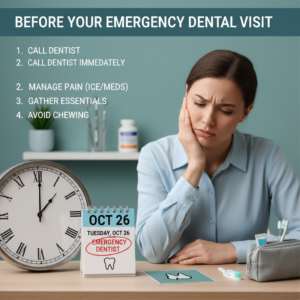
When you are actually in the middle of a dental crisis, your first priority is safety and relief. Coverage questions still matter, but they should not keep you from getting the help you need.
You can follow this basic approach:
- If you have severe pain, fever, uncontrolled swelling, or heavy bleeding, call your dentist immediately. If you cannot reach a dentist, go to a hospital emergency room, especially if you have trouble breathing or swallowing [5].
- For urgent but not life‑threatening problems, such as a broken tooth or lost filling, call an emergency dentist and explain your symptoms. Ask whether they are in your network and if they accept your insurance.
- Bring your insurance card and photo ID to your appointment, along with any medications you are taking.
- Ask for a clear explanation of recommended treatments, how they will be billed, and what your share is likely to be.
After your immediate problem is treated, schedule a follow‑up visit with your regular dentist to confirm that healing is progressing properly and to coordinate any additional care you may need [3].
If you already know that you want an insurance accepted provider who can see you quickly, consider contacting a practice that emphasizes emergency dentist that accepts insurance and same‑day or walk‑in availability.
Moving forward with confidence
It is normal to worry about cost when you think about emergency dental care. By choosing an insurance accepted emergency dentist, understanding how your policy works, and knowing your payment options, you put yourself in a stronger position to protect both your health and your budget.
You do not need to figure all of this out alone. A trusted emergency dental office will help you verify your insurance, estimate your out‑of‑pocket costs, and design a payment solution that fits your situation. With the right guidance, you can get the urgent treatment you need today, while keeping longer term financial peace of mind in view.